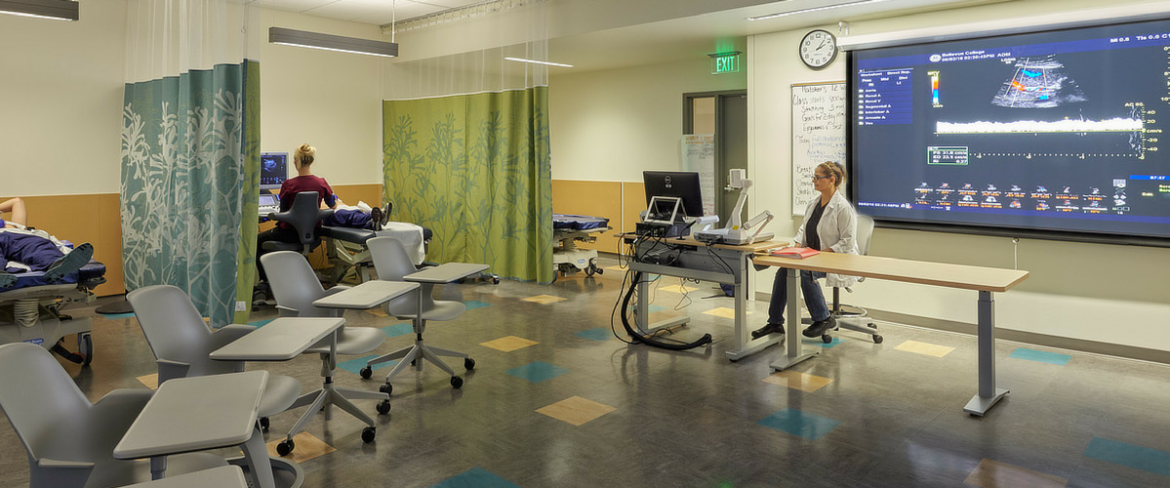
Bellevue College offers an Associate of Applied Science (AAS) degree program that provides educational and clinical experience as preparation for employment and national certification as a diagnostic medical sonographer. Our program has a selective admissions program which includes specific procedures and requirements that differ from other programs. These must be followed closely in order to be considered for the program.
Diagnostic medical sonographers, echocardiographers, and vascular technologists are a highly skilled individuals qualified by academic and clinical experience to provide diagnostic imaging services using ultrasound and related diagnostic techniques. Graduates are eligible to apply for and take the American Registry of Diagnostic Medical Sonographers’ National Certification examination.
2026 Application Update: The Diagnostic Ultrasound Technology program (Adult Cardiac concentration) is accredited by the Commission on Accreditation of Allied Health Education Programs (www.caahep.org) upon recommendation of the Joint Review Committee on Education in Diagnostic Medical Sonography (JRC-DMS).
Bellevue College was informed by the Commission on Accreditation of Allied Health Education Programs (CAAHEP) that the Abdomen-Extended, OB/GYN, and Vascular Concentrations of our Diagnostic Ultrasound program were withdrawn from the accredited list. The Diagnostic Ultrasound Program at Bellevue College has a site visit scheduled for pursuing initial accreditation (in Abdomen-Extended, OB/GYN, and Vascular concentrations) by the Commission on Accreditation of Allied Health Education Programs (www.caahep.org). This step in the process is neither a status of accreditation nor a guarantee that accreditation will be granted.
CAAHEP
9355 – 113th St. N, #7709
Seminole, FL 33775
Tel: (727) 210-2350
Fax: (727) 210-2354
Bellevue College is accredited by the Northwest Commission on Colleges and Universities (NWCCU)
8060 165th Ave NE, Suite 100
Redmond, WA 98052
Regional accreditation of post secondary institutions is a voluntary, non-governmental, self-regulatory process of quality assurance and institutional improvement.
Bellevue College junior and future vascular sonographer, Ashley Whitman, was one of four nation-wide recipients awarded an Anne Jones Scholarship. The Anne Jones Scholarship Fund of the Society of Vascular Ultrasound grants one $2,500 and three $1,000 annual educational scholarships for eligible students currently enrolled in an accredited dedicated vascular ultrasound technology program which offers an associate or bachelor’s degree in the profession. It was established in 2005 to honor the many contributions of Anne Jones, RN, BSN RVT RDMS FSVU former SVU President (1985-1986); former Chair of SVU’s Government Relations (now Advocacy) Committee. Ashley was selected based on academic achievement, college and community service, financial need, as well as extraordinary enthusiasm and commitment in pursuit of her vascular ultrasound career. Ashley was awarded a $1,000 scholarship.
Website manager is Suzanne Lane.