
This page features news and updates about RISE activities and initiatives.
BC Students experience life as researchers at the UW Undergraduate Research Symposium
May 2026 – A first-generation American student watched, surprised, as a steady stream of strangers stopped to read her comic strip and tell her it reminded them of their own families. Upstairs, a musician-turned-psychology student walked fellow students through months of data on parenting styles and motivation, describing the process as “solving a mystery in the tea leaves of data.” And across campus, two students picked up a guitar and a hammered dulcimer and improvised their way through a piece with no fixed notes, just a shared system of cues.
On May 15th, twenty-five Bellevue College (BC) students, including the four described above, several of them first-generation college students and Running Start high schoolers, presented research projects or performed in the performing arts session at the University of Washington’s (UW’s) 29th annual Undergraduate Research Symposium. It was the largest contingent BC has ever sent to the event. For many of these students, doing an undergraduate research project and presenting it was more than an academic exercise: it was an opportunity for self-discovery, collaboration, mentorship, and to see themselves as researchers for the first time.
The UW’s Undergraduate Research Symposium is the largest undergraduate research symposium on the West Coast, this year featuring over 1300 presentations and representing over 100 disciplines. Each year, UW invites local community and technical colleges, including Bellevue College, to participate. BC’s RISE Learning Institute, which works with faculty to support undergraduate research and project-based learning, helped coordinate the college’s participation in this event.
To participate, students worked with an instructor to do a research project and then wrote an abstract, created a research poster or presentation about their research project, and shared their results, just as they would at a professional or academic conference. For many students, this was also a chance to network and engage in scholarly discussions with others who had similar interests.
The personal is universal
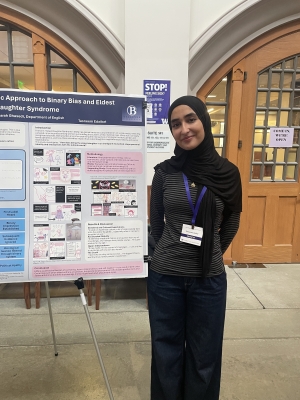
Tasneem Edaibat used the autoethnobiography project in Prof. Sarah Ghasedi’s English class to explore the phenomenon of Eldest Daughter Syndrome (EDS). For this project, students spent the quarter exploring a subculture that they belonged to or identified with and then looked at how their personal experiences connected to larger cultural, political, or social trends. EDS can occur when disproportionate emotional and caretaking responsibilities are placed on eldest daughters. It shapes how eldest daughters interact with people outside their households. After analyzing therapist writings, clinical (psychological) frameworks, social media TikTok videos, and conducting interviews with eldest daughters, Edaibat created a comic strip to represent the lived experiences of EDS within families. She found that eldest daughters in Arab and Sudanese cultures are often pressured to grow up quickly and asked to take on “adult” responsibilities. For some eldest daughters, this can make them more resilient, independent, and unafraid to take on new challenges. However, being cast as a caretaker and made responsible for others can teach some eldest daughters that they should put others’ needs first and to distrust others (because they are supposed to be responsible). For Edaibat, “Presenting at the UW Undergraduate Research Symposium was surprisingly rewarding. I found that the research I did and the subsequent project I created in comic form resonated with so many people that came around to talk to me. The atmosphere of the symposium is so busy but I found many people were willing to come, learn, and share about their own experiences which gave me new ideas for my research.” In fact, Edaibat is thinking about starting a podcast about EDS and contacting publishers once she’s developed her comic strip further.
Becoming a Researcher
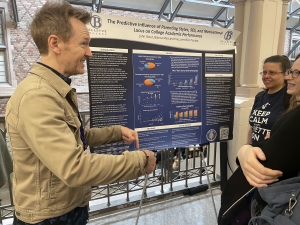
For other students, completing a research project helped them see themselves, often for the 1st time, as researchers. Students John Stout and Bianca Mascarenhas, working with Psychology instructors Dr. Celeste Lonson and Prof. Jennifer Parada, researched the impact of parenting style on student academic motivation. To assess this connection, Stout and Mascarenhas surveyed 126 students at Bellevue College and Eastern Washington University about how they perceived their parents’ parenting style and whether they identified their motivation for academic success as being intrinsic (something they want) or extrinsic (something a parent wants or because they want a specific reward, like a job). They also analyzed other factors, like socio-economic status, whether the students came from a single or dual income family, and age.
A musician by training, Stout didn’t expect to become so engrossed in analyzing the vast amounts of data they collected. Stout noted that,”From the outside, data analysis can sound dry, but it’s very much like solving a mystery – particularly exploratory analysis. You’re seeking the ‘why’ of person’s behavior in the tea leaves of their data.”
Their work drew recognition beyond the UW symposium as well. Stout and Mascarenhas also presented this poster at the Washington Psychological Association’s annual conference and tied for first prize in the Psi Beta poster session!
Stout appreciated the chance to do this project because it helped him fulfill several prerequisites for grad school (in psychology), where he hopes to continue exploring the intersection between psychology and education. He noted, “I’m considering a follow-up on this year’s research, diving deeper into the impacts of academic motivation on long-term memory. It would also be interesting to see how changes in our current educational environment (in-person vs virtual courses) may correlate with students’ motivation and achievement.”
Being able to complete the entire research cycle – from forming a hypothesis to doing background research to gathering and analyzing data to understanding and sharing results – is a process that not many students get the chance to undertake as undergrads, especially as freshmen and sophomores, when they are typically just learning foundational research skills and about the tests or tools that specialists in their field commonly use.
An opportunity to collaborate and mentor
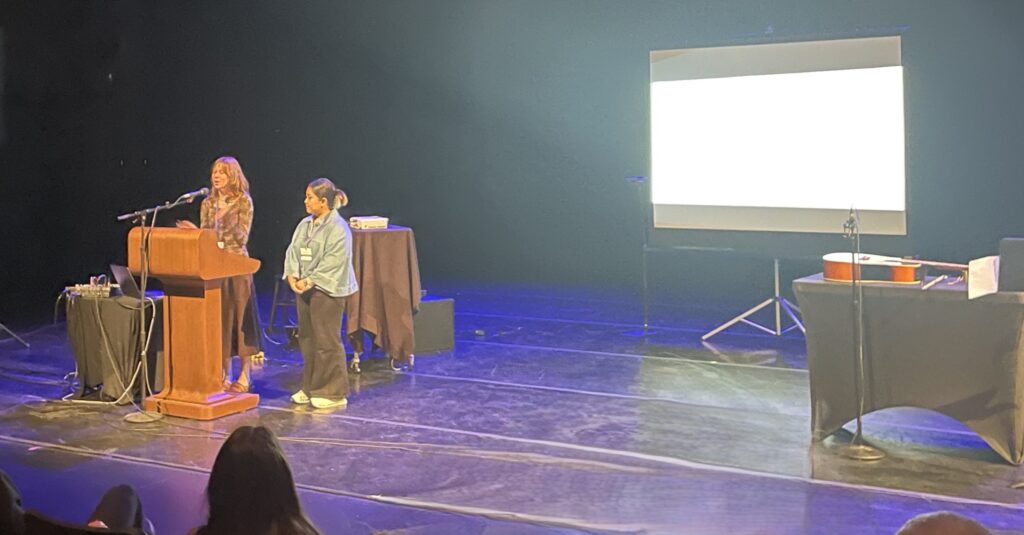
Kate Schwendiman and Nattira Chaiprasit worked with guitar instructor Prof. Naeim Rahmani to learn an alternative musical notation style. Unlike traditional sheet music, which tells the musician exactly which notes to play and how to play those notes, Schwendiman and Chaiprasit learned about local composer Tom Baker’s graphic notation system, which indicates the sequence and volume that each musician should play, but leaves everything else up to the musician. As a result, instead of focusing on playing a piece “the right way,” playing becomes an act of co-creation, where the musicians continuously play and respond to each other. Schwendiman and Chaiprasit began their presentation by tying this approach to the Avant-Garde movement of the 1950s and explaining how Baker’s musical notation system worked. Then, they performed a Tom Baker piece called “Shendo No. 5.” Instead of sitting, Schwendiman laid an acoustic guitar flat, sometimes plucked, sometimes tapped, and sometimes used a bow to play it, while Chaiprasit played a hammered dulcimer. They note that,“When playing through the piece, we had to collectively negotiate musical form through active listening, visual cueing, and real-time decision-making. Across multiple performances, we observed that the freedom we were given allowed each performer to contribute in unique ways. Successful performance required focus, as timing and responsiveness directly affected the overall sound. The absence of fixed notation transformed the act of performance into an active process of collaboration and creation.” Chaiprasit credited Prof. Rahmani’s mentorship with helping shape the piece, noting that he “brought his vast experience to suggest things that might sound good at the right moments.” Going forward, Chaiprasit hopes to record their Shendo renditions professionally, and create a space at Bellevue College where other musicians can bring their own musical tastes and collaborate.
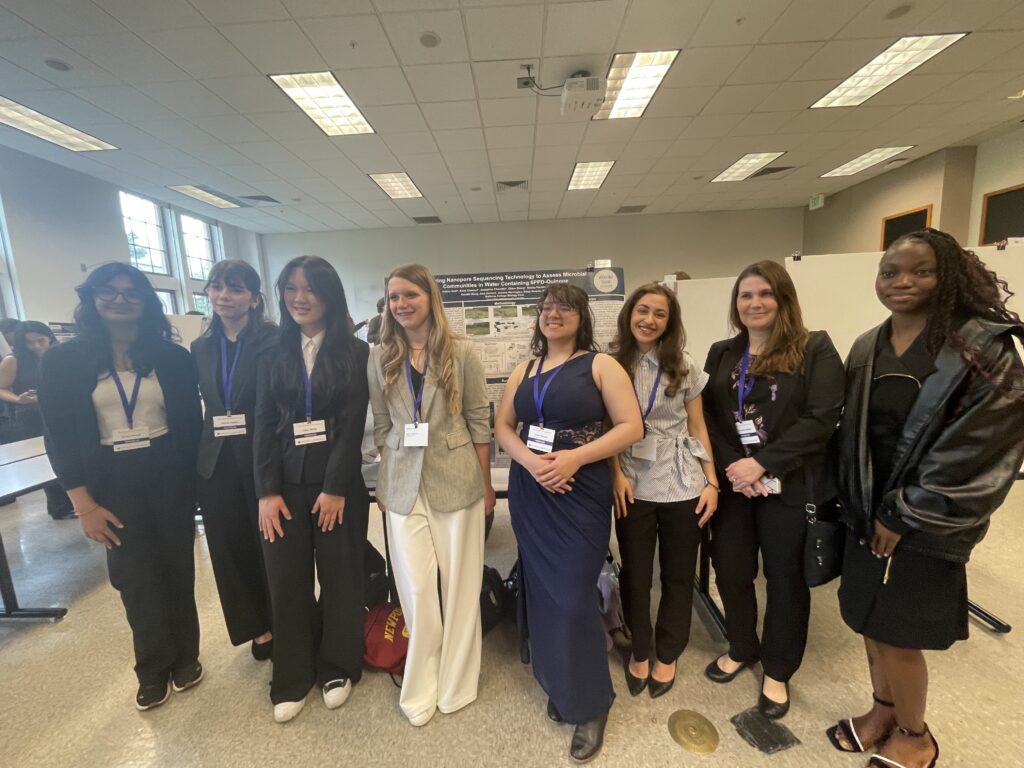
Members of the Biology Club worked with club advisor Dr. Stacy Alvares to analyze the effect of stormwater contaminant 6PPD-Q, which is formed from vehicle tire particles, on aquatic microbial communities in a local pond where coho salmon reside. Public agencies often use filters called Bioretention Urban Retrofits (BURs) to remove pollutants like 6PPD-Q. In their study, students collected water samples from either side of a BUR installed near that pond and then analyzed the DNA from microbial communities in each sample using nanopore technology, a DNA sequencing method for quickly and easily identifying organisms in a sample. They expected to see specific bacteria in the samples taken from the “unfiltered” side of the BUR that have been linked to 6PPD-Q exposure. By confirming the association between those bacterial strains and the presence of 6PPD-Q and then using cheaper tools for confirming the presence of those bacteria, students hoped to help people develop a faster and more efficient way to test for 6PPD-Q, which has been linked to killing salmon and other aquatic life.
For Biology Club president Katina Hadi, being involved in this project helped her develop important leadership skills. Hadi noted that, “From a leadership standpoint, I had the opportunity to work on my troubleshooting skills as research can be unpredictable, and there were several instances where we encountered problems during our data collection. During this time, I became much more comfortable helping to run the labs, helping team members out here and there, and delegating tasks so newer members could gain essential hands-on experience with various laboratory procedures.”
For BC students, participating in the research projects described above opened doors that they never imagined at the start of their journeys. Tasneem discovered that the experiences that she thought were unique had components that cut across cultures as well as a talent for reaching a broad audience with her artistic skills. Katina discovered that leading a research team gave her the chance to mentor younger students and develop leadership skills and Kate and Nattira discovered a musical format that invites collaboration and improvisation. For students like John, doing undergraduate research projects was an important step in advancing his career. None of that happens without a question worth asking, data worth analyzing, instructors willing to guide the process, and a venue to share findings. This year, with the support of the RISE Learning Institute and seven dedicated instructors, twenty-five BC students found all these things.
3 BC Instructors Selected to attend the WA CURE Academy
RISE is excited to announce that Profs. Christina Sciabarra, Celeste Lonson, and Jennifer Parada have been selected to attend the WA CURE Academy, a cohort-based professional development program developed to help teams at various institutions expand opportunities for doing undergraduate research.
Profs. Sciabarra, Lonson, and Parada will attend a 2-day retreat in the summer of 2027 and then receive ongoing training and support as they develop modules in Canvas focused on qualitative and quantitative social science methods. They hope that these modules, which will be available to all faculty, will help make undergraduate research a more consistent and accessible experience across social science disciplines. After developing these modules, Profs. Sciabarra, Lonson, and Parada plan to hold a faculty training workshop in conjunction with the Faculty Commons; provide ongoing technical support; and organize a Social Science student research showcase to complement the RISE Making Learning Visible showcase.
According to Prof. Parada, motivation to pursue this project came in response to feedback that faculty want to integrate research into their teaching but often lack the time, resources, or support to do it. Profs. Sciabarra, Lonson, and Parada focused on both qualitative and quantitative methods because Social Science students need fluency in both, and building shared resources in Canvas is the most equitable and sustainable way to share and provide access to those materials.
The WA CURE Academy is sponsored by WA CURE, the Washington State Consortium for Undergraduate Research and Equity. WA CURE is a statewide consortium funded by the National Science Foundation. Its mission is to integrate undergraduate research into courses at WA State community and technical colleges.
For more about WA CURE and the WA CURE Academy, go to the WA CURE website.