A Look Back at Bellevue College’s History
Jan 3, 2026From its modest start at a high school campus in 1966 to its 100-acre campus today, Bellevue College has seen its share of change in the last 60 years.
From its modest start at a high school campus in 1966 to its 100-acre campus today, Bellevue College has seen its share of change in the last 60 years.
Now the largest open-access college in the state of Washington, offering the most bachelor’s degrees of all community or technical colleges, Bellevue College is consistently recognized for its strong return on investment, high academic rankings, and its far-reaching impact in educating students from around the state.
But its success today is due in large part to the 60 years of strong foundation built by faculty, staff, and leadership from the greater Eastside region.
“One of the interesting things about Bellevue College is that the college was actually founded only 15 years after the City of Bellevue incorporated,” Bellevue College President David May said. “We weren’t an institution that came later. We were here when Bellevue was a quiet little suburb, and what we’ve done is innovate with the city, with the community, and we’ve built this together. For me, that’s incredibly powerful.”
Beginnings
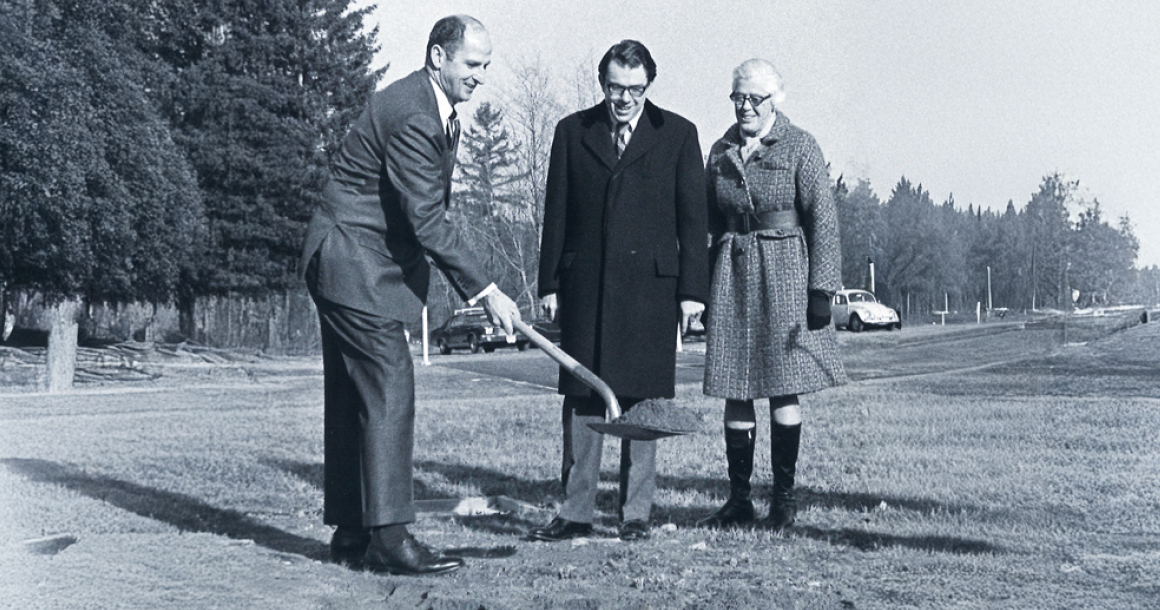
Opening on Jan. 3, 1966, the college got its start with evening classes located at Newport High School and faculty and staff offices housed in portables. Early accounts claim about 50 people camped out overnight to be first in line to register when college registration opened. In the first two days, 295 students were registered for classes, enrolling approximately 500 students that first year.
The community’s college of the Eastside was finally open.
In the years after its opening, student enrollment continued to grow for the two-year community college, as did plans for its future expansion. The Washington State Legislature passed the Community College Act of 1967, creating state community colleges and community college districts. As a result, Bellevue Community College joined a unified state system, separating from the Bellevue School District.
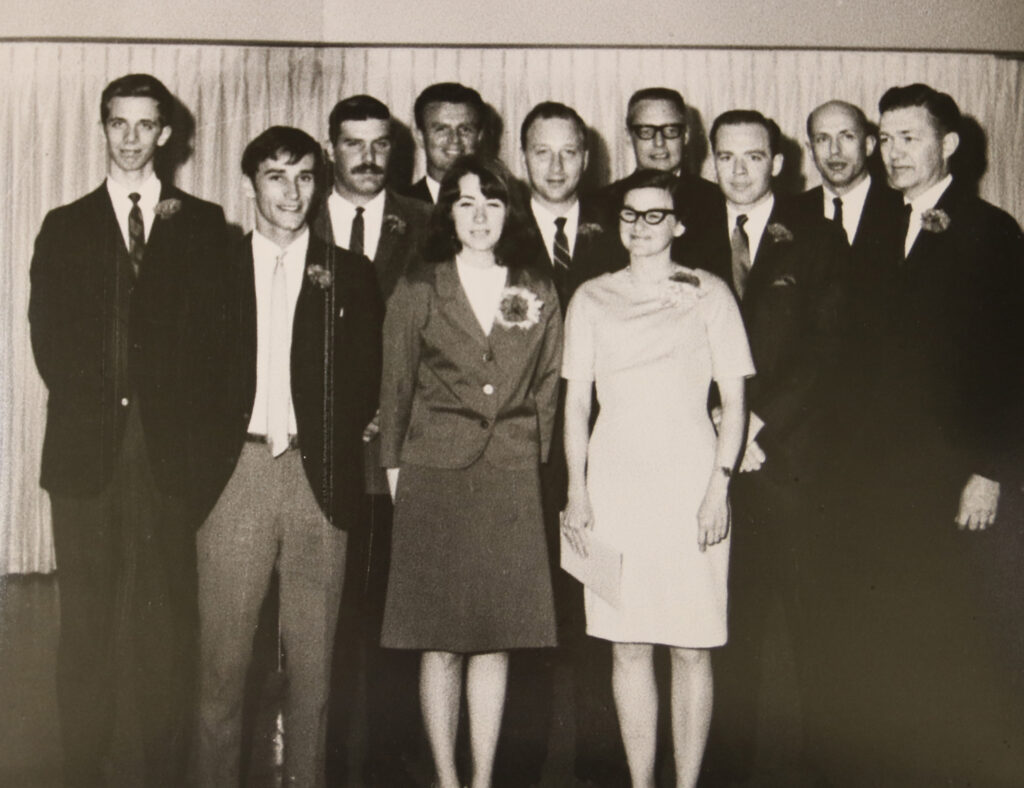
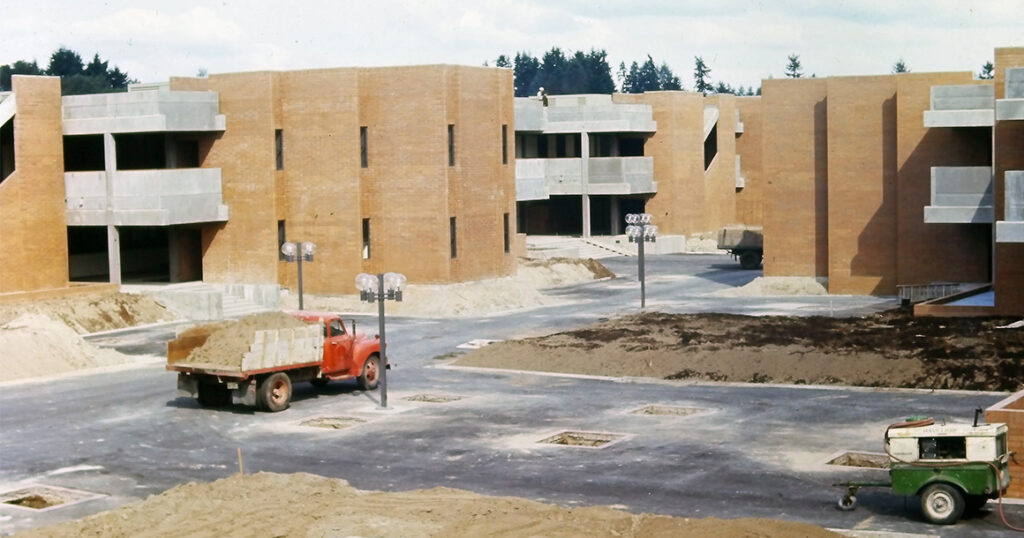
That same year, the Board of Trustees selected Dr. Merle E. Landerholm as the college’s first president and held the first commencement for a 25-student graduating class, 15 of whom earned their high school diplomas. By the end of the year, construction began on a new college campus – a 96-acre, $6 million project that would open in 1969 and go on to become the campus the community knows and loves today.
Looking back on his first 21 months of construction, President Landerholm said in his annual report to the board: “We dealt with monumental problems, and we dealt with minutia. Each hurdle seemed a little higher and more difficult than its predecessor. And this is just the beginning.”
A Decade of Firsts
There were a lot of firsts for Bellevue Community College during its first 10 years. The first group of Associated Students of Bellevue Community College was elected, the first student newspaper, The Jibsheet, was published, and intercollegiate athletics were formed. Students were hungry to learn and embraced a lecture and concert series, current-issues discussion forums, and eight major dances.
The college constructed Carlson Theatre, named after the late drama instructor Bud Carlson, and fundraised for the Willard Geer Planetarium, named after its first physics instructor Charles Willard Geer. A gymnasium, a day care center, classrooms for welding, radiologic technology, horticulture, and an athletics track and field were completed by 1975.
Alongside its growing physical presence, faculty and staff expanded programs and services, too. In 1970, the Minority Affairs Program was founded in an effort to serve all students, regardless of ethnic or cultural heritage. The program led to the creation of the Black Student Union. Shortly after, a women’s center was established, and women’s sports began with volleyball and basketball.
Technology started to play a larger role on campus, streamlining registration and providing students with new ways to learn. A popular service tool of the college’s Library Media Center, affectionately called “Chester,” allowed students to “dial in” to receive as many as 48 different recorded audio programs and class lectures. The college expanded staff communications platforms as well. The KBCS radio station and the BCC College Channel broadcast college information and courses to prospective students and the community.
By the mid-1970s, Bellevue College had nine instructional divisions: Allied Health, Business, Creative Arts, Home and Community Education, Humanities, Individual Development, Physical Development and Performance, Science, and Social Science. Students were most interested in cashier training, diver certification, environmental horticulture, fashion merchandising, graphic reproduction technician, and media technician programs.
Continued Growth
From the mid-1970s to the ‘80s, the Bellevue Community College Foundation was created to fundraise for student scholarships, the college expanded its presence to the North Campus – the original location of its Continuing Education department until recent years, and it constructed the K Building. By 1986, the college was celebrating its 20-year anniversary, engaging with alumni through its new BCC Alumni Association, and offering telecourses for the first time on its cable television channel, a resounding success. That first summer, more than 500 students enrolled in the new instructional modality.
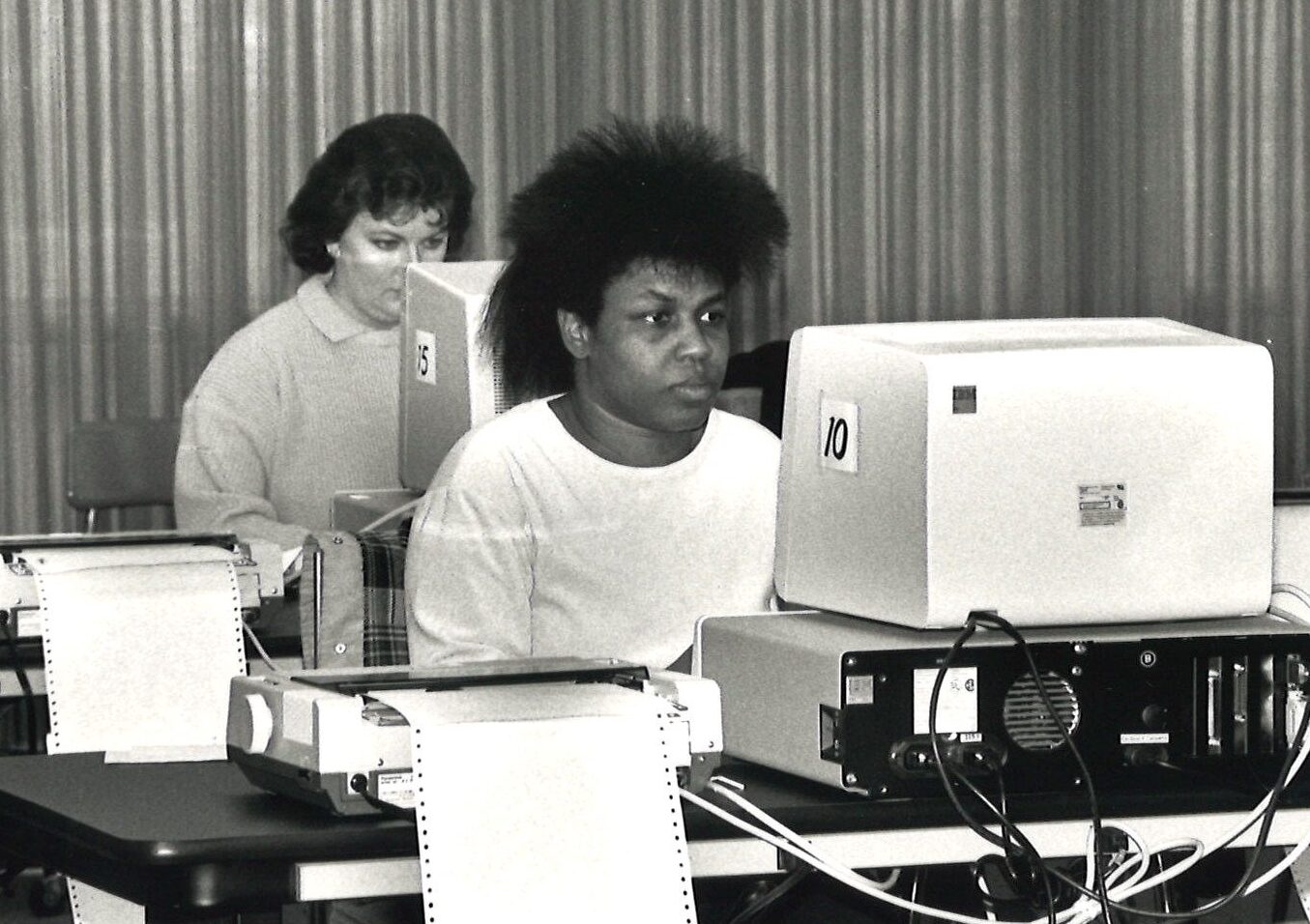
“Forty years ago, it was 16-millimeter films and slide projectors,” said Larry Boykin, a Bellevue College alum and current employee, of instructional technology. “The next thing you know, we moved away from videotapes and into DVDs.”
Boykin, who began at the college as a student in 1983, pursued a degree in media communications and became a multimedia technician in the eLearning program.
“I remember one time I was running around during finals week so much so that I almost ran over a couple of faculty trying to get equipment from one area to another,” Boykin laughed. “I always said, jokingly, if I ran you over with a cart trying to get from one room to another, to make sure I got there in time, I want to apologize. But if I didn’t run you over, I will get you next time.”
Revolutionary Changes
With the beginning of the last decade of the 20th century in sight, the Board of Trustees selected B. Jean Floten as the college’s seventh president. President Floten would go on to serve as college president for 22 years, retiring in 2011.
“Those early years at Bellevue College were electric,” Floten recalled. “The Information Technology Revolution was just beginning, and many of its pioneers were right in our backyard. I wanted to learn from these trailblazers and discover how we could create opportunities for our students to join the amazing new and transformational revolution.”
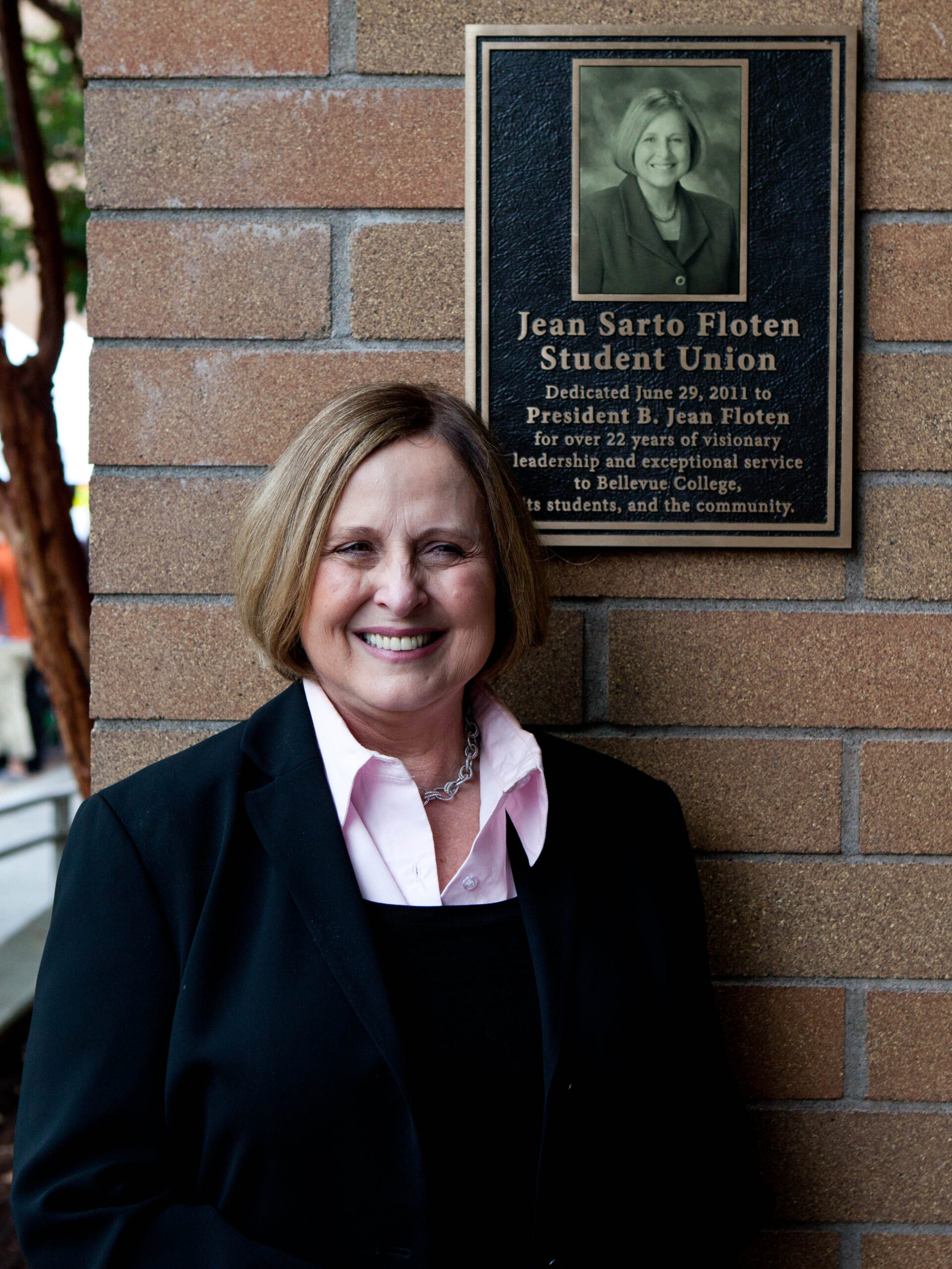
During Floten’s leadership, the college launched programs in IT, software development, bioinformatics, biomedical technology, medical specialties, and aerospace.
The early 1990s saw its highest student enrollment yet with nearly 18,000 students in large part due to the launch of its Running Start program in 1992. The dual-credit program gives students the opportunity to earn both high school and college credit at the same time and is a program that has had success up to the present day.
To respond to Bellevue Community College’s growth, a Student Services building, which serves as the location for its bookstore, was constructed along with a NorthWest Center for Emerging Technologies, thanks in part to a $3 million National Science Foundation grant. The center became known as the N Building and shares space with the Washington State Archives.
Before the end of the 1990s, the college’s first website was launched, and another new classroom building, the L Building, was added.
“I saw the computer lab get built, the R Building, the L Building – so the N, the R, the L, the S, the T, and the U, and the gym got renovated, and I saw the parking garage being built,” said Bellevue College alum and current employee Glenn Jackson. “So, about seven buildings I can name right off.”
Jackson, Bellevue College’s associate dean of High School Initiatives, started at the college in 1997 as a cook. He worked as both an employee and as a student at the college, earning his associate degree as he grilled in the cafeteria. Jackson went on to earn his bachelor’s and master’s degrees before transitioning into enrollment services and eventually growing the Career Education Options (CEO) program into what it is today.
“I stop and think about where I came from,” Jackson said. “You know what I mean? It makes me reflect and it helps me to empower other students. It’s not how you start or where you’re at, currently. Think about what you want to do.”
Expanding Access
By the early 2000s, Bellevue College’s online services now offered a full range of options for students, including online admissions, class registration, grade access and program information. Enrollment had reached a high of 39,300 students. Services – such as an Early Learning, Family, and Childcare Center, and Occupational and Life Skills program – were being designed and implemented to serve the college’s increasingly diverse student population.
At the same time, advancing diversity, equity, and inclusion became a collegewide priority. In 2006, the college was the first Washington state community college to launch an Office of Equity and Pluralism.
“I saw how this college can work together, how they’ve rallied together for different things that have happened in the United States,” Jackson said. “I’ve seen them fragmented, but I’ve also seen them united. I know they can work together.”
Leading up to the new office’s creation, Leslie Lum, a Bellevue College business transfer instructor, said she and others founded the Diversity Caucus, which created trainings, programs, and events focused on teaching about and celebrating people with different ethnicities, backgrounds, and cultures. One said event was instructor Phil Lucas’s American Indian Film Festival.
“The film festival showed 100 films and was phenomenal for collaboration between the Native American community and the college,” Lum recalled, noting Lucas was from the Choctaw tribe. “He’d choose the films but let Indigenous students choose too. He would bring people from Indian Country and there would be professors from UCLA, American Indian dancers, drummers, people building canoes, all for four days, and he would do it every year.”
When Lucas passed away, Lum said the community came together to honor his life in a meaningful way at Carlson Theatre.
“It was packed with over 300 people,” Lum recalled.
Bellevue College’s reputation for being equity-centered began to grow and the college was commended by four national awards:
- The NAFSA Sen. Paul Simon Internationalization Award
- Charles Kennedy Equity Award from the Association of Community College Trustees
- The John L. Blackburn Award for Exemplary Models of Administrative Leadership
- The Minority Access Award
Bellevue College and Brutus were Born
Around that same time, in the early-to-mid 2000s, the college’s student body held a vote to change the mascot from The Helmsman to the Bulldogs.
“I fielded questions all the time – What is a helmsman?” Bellevue College’s Athletics Director Jeremy Eggers said of his time as a basketball coach in 2004. “My athletics director came up to me and said, ‘The campus is thinking about changing the mascot.’ My understanding was there were some female athletes who pointed out that there were no female helmswomen.”
Although the voting turnout was small, the Bulldogs won and Brutus, the Bellevue College Bulldogs mascot, was born.
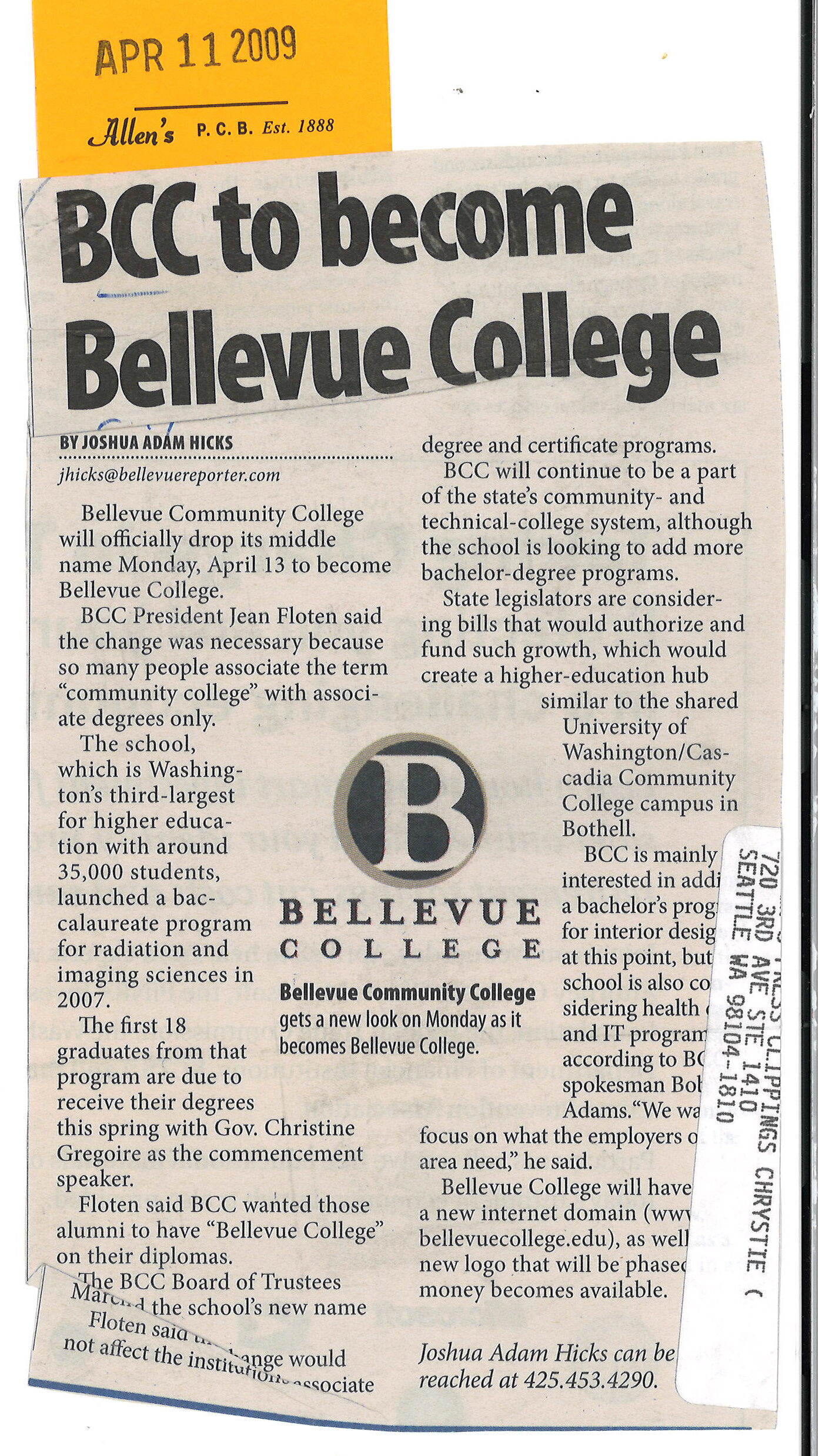
By 2009 the college would face another major change – the expansion of its degree offerings and the change of its name. Bellevue Community College became Bellevue College in April 2009. Its strong transfer programs grew to include applied bachelor’s degrees; four-year degrees students could earn outside of the typical university institution. Its first Bachelor of Applied Science degree was in Radiation and Imaging Sciences. The program graduated its first cohort in 2009. That same year, a Bachelor of Applied Arts in Interior Design was added to the course catalog.
Since then, the college has climbed to offer 15 bachelor’s degrees focusing on preparing students for careers in healthcare, technology, business, STEM, and interior design. In 2016, the college was the first in the community and technical college system to offer a Bachelor of Science in Computer Science in an effort to respond to the growing demand in the industry.
Environmental Sustainability
Throughout the 2000s and 2010s, environmental sustainability began to form as a pillar of Bellevue College’s identity. After the college became a signatory of the American College and University Presidents’ Climate Commitment in 2007, leadership adopted its first Climate Action Plan and created the Office of Sustainability. The first electrical vehicle charger was installed on campus as the first “fast charger” on any college or university campus across the entire western United States.
“Sustainability is very important to everything we do here at Bellevue College,” President May said. “It’s built into our DNA. Our 100-acre, beautiful campus is a designated Level II arboretum, we have many native plant species labeled in both English and Lushootseed, and we work very hard to ensure our new buildings are LEED certified.”
In addition to statewide and national awards the institution has received for its commitment to sustainability, work continues to ensure the college is prepared to last long into the future. In 2024, Bellevue College updated its Climate Action Plan to include the ambitious goal to become carbon neutral by 2050.
Innovative Instruction
As students became increasingly more tech-savvy, so did instructional tools in the classroom. In 2012, the college purchased software called Virtual Environment Radiotherapy Training (VERT) to teach Radiation Therapy students life-saving skills to treat cancer. The innovative technology helped educate students and address critical shortages of training facilities needed for radiation therapists. By 2017, faculty had launched an XR Lab with a visiting professor, giving students the opportunity to learn in virtual reality, augmented reality, and extended reality.
Just one year later, in 2018, faculty and staff launched the Research, Innovation, Service, and Experiential Learning (RISE) Learning Institute and the state’s first artificial intelligence associate degree in the state.
The next two years would see the campus expand once again to include a residence hall, accommodating 400 students, and the Student Success Center, a 69,000-square-foot building called the U Building.
Just as the college was experiencing on-campus growth, prosperity, and excitement, the COVID-19 pandemic hit in 2020, sending students home and faculty and staff into online and hybrid environments.
“Once COVID hit, everything fell off,” Jackson recalled. “Even after COVID, we spent three years at home. When we started coming back, people who used to hug me… I was a little standoffish.”
Still, Bellevue College persisted.
Awards and Recognition
The college’s Neurodiversity Navigators program, a program designed to help neurodivergent students, was ranked No. 1 nationally in 2020. By the end of 2022, the college had celebrated its first LGBTQ+ rainbow crosswalk on campus, joined a partnership with the University of Washington Bothell for the UW Bothell School of Business’ Eastside Leadership Center, and joined the Amazon Career Choice program, which helps Amazon employees afford college tuition.
Current Bellevue College President David May was hired the following year after former Washington state governor, Gov. Gary Locke, filled the interim role for three years.
Since then, the college has been recognized nationally. First by the Aspen Institute when Bellevue College was nominated to apply for a prestigious Aspen Prize in both 2023 and 2025, and second, when it won an Achieving the Dream Leader College designation for its work toward closing equity gaps. At the international level, the college’s International Education department renewed its partnership with Complexe Scolaire Bellevue, a sister institution located in the Democratic Republic of Congo, providing greater access to college education for students around the world.
Student success is also seen across the country. In 2024, Bellevue College’s DECA team won national championships for the 10th year in a row and in 2025, the Model UN student team won the Distinguished Delegation Award at the 2025 National Model United Nations conference in New York.
Preparing for Future Student Success
In its forward-thinking capacity, the Board of Trustees adopted new mission, vision, and values statements in 2025, informing and aligning the college’s strategic planning process.
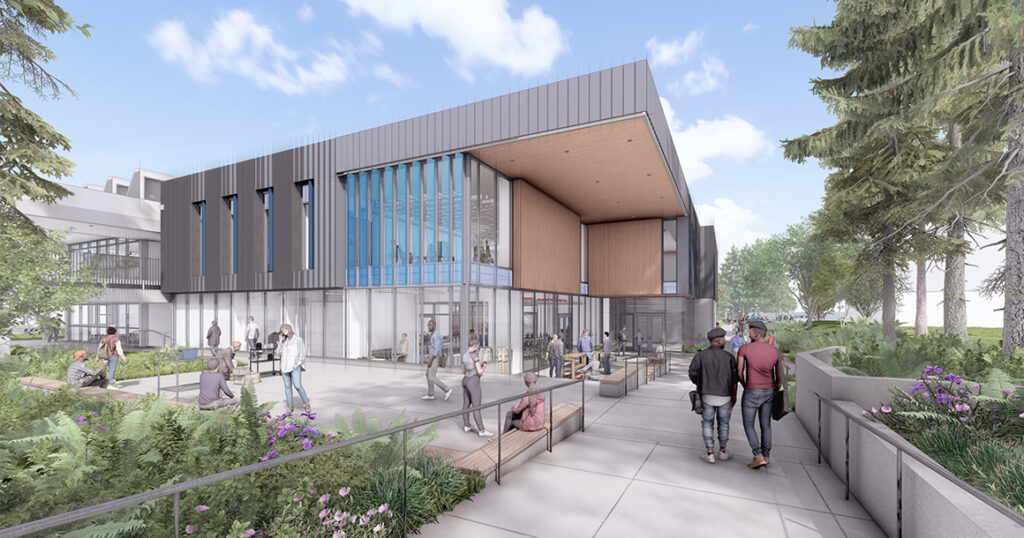
And Bellevue College broke ground on a new building, once more – the W Building.
“The W Building is an incredibly important space where technology and traditional arts are going to meet and merge to help prepare students for those interdisciplinary workforces that we know they’re going to,” President May said, noting that it will be the new location for the college’s makerspace, a space with 3D printers, laser cutters, and boundless opportunity.
Slated for completion toward the end of 2026 and opening to students in January 2027, the W Building is a symbol of what’s ahead for Bellevue College. It represents a place where innovation, creativity, and transformation converge. It represents a place of learning for and by the community by which it serves.