
College Tests New AI-based Civic Innovation Apps
Feb 4, 2026As a regional innovation hub, Bellevue College is looking for and finding opportunities to apply artificial intelligence (AI) technology to solve challenges, both internally and externally.
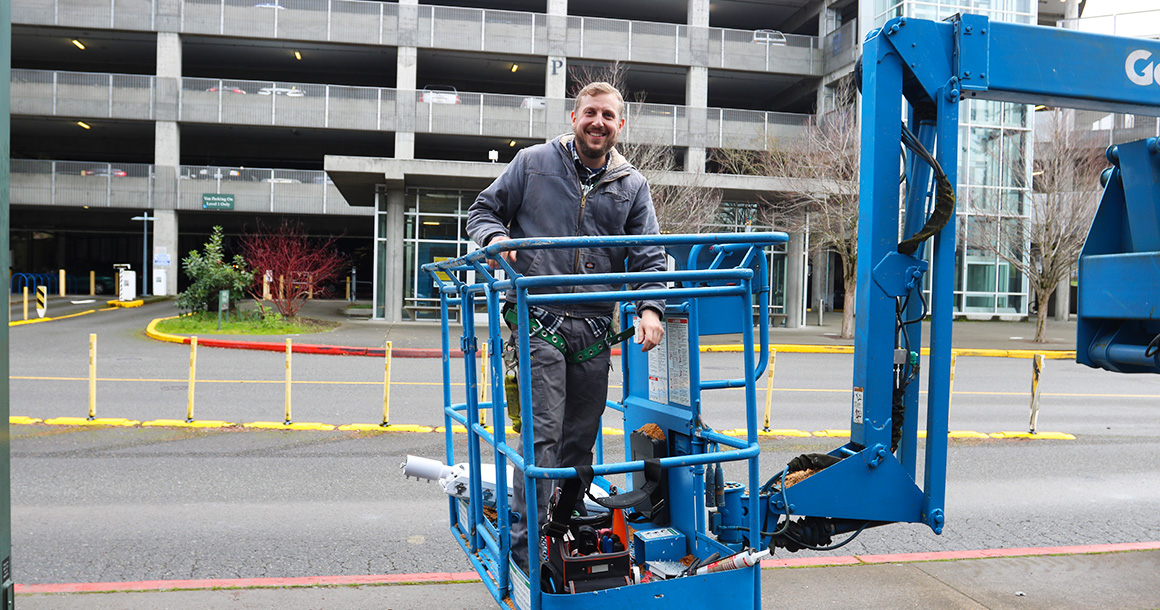
As a regional innovation hub, Bellevue College is looking for and finding opportunities to apply artificial intelligence (AI) technology to solve challenges, both internally and externally.
A recent partnership with the City of Bellevue’s Civic Innovation Challenge initiative has resulted in two pilot programs using AI to improve safety and operations at Bellevue College. The first, called FindIt, uses AI-generated object descriptions to help people find missing items on campus, augmenting the traditional lost-and-found process. The second pilot project, from an organization called Juganu, uses AI sensors attached to light poles to improve transportation and pedestrian safety.
“Bellevue College is the perfect place to test civic innovation,” said Jorge de la Torre, Vice President of Administration at the college, “We’re basically a mini city, with a contained but realistic environment filled with buses, public access, pedestrians and cars. As a technology-forward campus, we can quickly implement and test apps that are in alignment with what we’re trying to achieve and get meaningful data from diverse data. We’re excited about partnering with the city to pilot these apps.”
The Civic Innovation Challenge is a new initiative sponsored by the City of Bellevue, where the city seeks technology projects to improve civic operations, and offers grants to companies and individuals to pilot projects and collect data on which technologies offer the best return for the city’s goals. The city conducted the selection granting process beginning in June 2025; Bellevue College (among others) is testing out the resulting selected projects in a real-world environment. The city and the college use technologies to make cities (and mini cities like the college) run better.
After reviewing and prioritizing submissions, in October 2025, the city picked four projects to fund; and entered into a pilot partnership with Bellevue College to try out two of the AI-based apps. Because the Civic Innovation pilots are on a speedy delivery timeline, Bellevue College selected two applications that could both be implemented quickly, and that aligned with the college’s existing mission and plans. The pilots were approved by the college’s board and reviewed by an internal team that included students and personnel from Human Resources, Public Safety, and the college’s infrastructure team.
FindIt and Juganu: AI-based Applications for Improving Operations
The first application to go into a pilot was FindIt, developed by a high school student in Bellevue. This AI-enabled app creates a database of found objects, with AI creating descriptions of each object from a photo. Then, people who have lost items on campus can search a database of found objects to see if theirs is among them. To discourage people from claiming items that are not their own, identifying details are not photographed for the database.
FindIt has been available for public use since the beginning of December 2025 and already shows great promise for helping connect lost objects with soon-to-be-happy owners. It is saving time and energy that may have been spent traveling to the lost and found office on campus, as well as reducing the number of items that end up in the landfill. According to de la Torre, the student developer has plans to extend the application for use at other schools, libraries, and institutions in Bellevue and beyond.
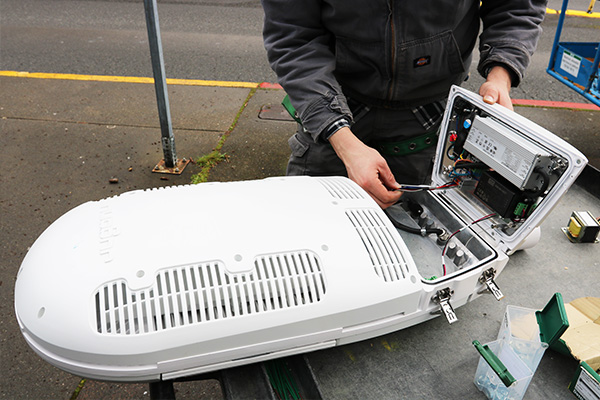
Juganu monitors pedestrian and car traffic and classifies traffic patterns, including unusual activity, dwell times, bottlenecks, and car accidents. It provides data on near-misses with vehicles, how long people are waiting for buses or to cross the street at crosswalks, and other data for the college to improve safety and traffic flow. It also provides better lighting with energy-efficient LEDs and video and audio sensors to monitor public safety.
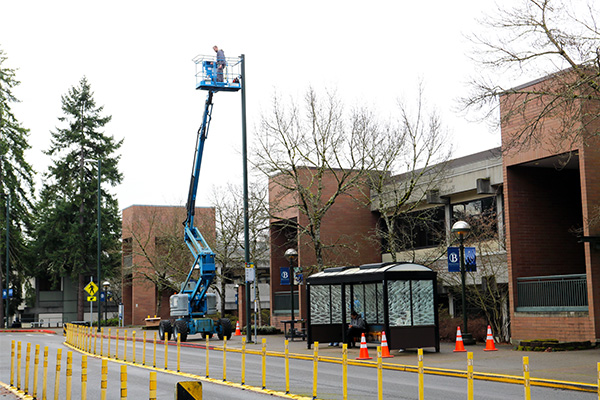
In February, the college placed the light sensors by the parking garage at two main crosswalks and a bus drop-off, and will be looking to see if it needs to make adjustments to traffic patterns. This data will come in handy as decisions are made this summer about re-striping crosswalks and potentially adding new stop and yield signs. The college will also use the data to improve emergency response measures.
The two applications also are aligned with the college’s policies.
“We made sure that the uses of these AI applications are both transparent and ethical,” said Fernando Moratalla, Director of Public Safety at Bellevue College. “We are not collecting any personally identifiable data, such as facial recognition or names; all data is anonymous and in the aggregate, and kept internally for the college’s use only. The benefit to the college is that we get access to leading-edge technology that may be useful in the future.”
Added de la Torre, “Both of the pilots are aligned with what we are already doing on campus; they are sustainable, they expand our ability to understand what’s going on at campus, they reduce processes and create a safe environment. They solidify our leadership position as a technology hub in the community. Overall, it’s clearly a win-win.”