
Washington Supreme Court Brings Justice to the Classroom
Nov 20, 2025Washington State’s Supreme Court justices left the marble halls of the Temple of Justice in Olympia and brought their proceedings directly to Bellevue College for two days, Nov. 12–13, as part of the Traveling Court program.
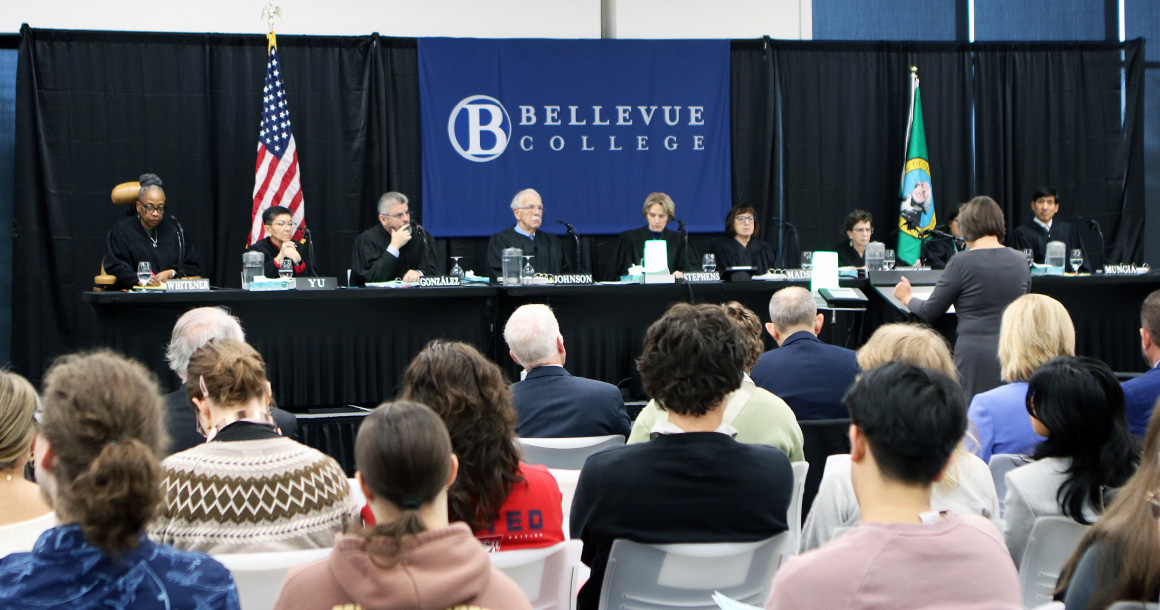
Washington State’s Supreme Court justices left the marble halls of the Temple of Justice in Olympia and brought their proceedings directly to Bellevue College for two days, Nov. 12–13, as part of the Traveling Court program. All nine justices visited the college to engage with students and the broader Eastside community, offering a unique opportunity to observe the judicial process up close and interact with the state’s highest legal authorities.
The visit marked the state Supreme Court’s third time on campus and its first since 2016. For Bellevue College’s diverse student body, the experience offered a personal connection to Washington’s judicial system, affirming the accessibility of justice.
“This event is a celebration of learning and wisdom shared by the members of the Washington Supreme Court, and it is a recognition of the deep and profound impact their work has on our lives,” Bellevue College President David May said. “Their decisions impact students, parents, community members, law enforcement, and lawmakers.”
Building Bridges Between Campus and the Court
The first day of the Traveling Court visit centered on engagement with the campus community. Five justices –– Stephen Gonzalez, Barbara Madsen, Raquel Montoya-Lewis, Sal Mungia, and Chief Justice Debra Stephens –– visited classrooms to speak with students about the court’s role, their career paths, and the importance of public service.
Later that day, a panel discussion offered further opportunities for dialogue. Justices Mary Yu, Sheryl Gordon McCloud, Charles Johnson, and G. Helen Whitener participated in a moderated Q&A session led by Professor Charlene Freyberg, chair of the Criminal Justice program at Bellevue College. Students, faculty, and staff asked questions about the justices’ experiences, legal reasoning, and the role of courts in democracy.
Justice Johnson encouraged civic participation, urging students to “volunteer” and stay active in their communities. Yu emphasized values such as empathy and compassion, telling students, “Cultivate those values we want to see most… We need to do this every day.”
Following the classroom visits and panel, the justices joined President May and members of the college community for a luncheon in the Gary F. Locke Ballroom. The afternoon included meetings with local legal professionals and preparation for the next day’s oral arguments.
Cases That Matter: Two Legal Battles on Center Stage
The second day brought the full measure of the Supreme Court’s authority and responsibility to campus as all justices convened with the Bellevue College community to hear oral arguments in two significant cases. The proceedings were broadcast live on TVW, Washington’s public affairs network, extending the educational reach beyond those who could attend in person.
The cases selected for argument reflected some of the most pressing and contentious issues facing Washington’s judicial system, providing students and community members with a window into the real-world application of constitutional principles and the complex challenges courts must navigate.
The first case, In re Detention of M.E. and R.S. (Case No. 103252-8), examined the intersection of constitutional rights and systemic capacity in Washington’s public defense system. While the case nominally concerned an individual facing involuntary civil commitment for mental health treatment, it raised fundamental questions about access to justice when public defenders are overwhelmed with caseloads that exceed professional standards.
The King County Department of Public Defense informed the trial court that it had reached maximum capacity and could not ethically take on additional cases, including representation for the subject at the center of the case, M.E., without compromising the quality of defense for all clients. The trial court ordered the public defender to accept the case anyway, arguing that the court’s obligation to ensure legal representation for those facing involuntary detention superseded caseload concerns. The public defender appealed, putting into question who is responsible when there simply aren’t enough attorneys to represent everyone entitled to representation.
For students in the audience, the case illuminated how abstract constitutional principles –– the right to counsel, due process, and access to justice –– collide with practical realities of government funding, workforce shortages, and competing institutional responsibilities. It demonstrated that the work of courts extends far beyond individual cases to address systemic failures that affect entire communities.
The second case, State v. Hogan (Case No. 103824-1), tackled the contentious issue of racial bias in jury selection, testing Washington’s groundbreaking General Rule 37 –– the first rule of its kind in the nation designed to eliminate discrimination in the jury box.
Nigel Hogan, a Black defendant convicted of felony murder, argued that prosecutors improperly used peremptory challenges –– the ability to dismiss potential jurors without explanation –– to remove individuals based on race or racial perception. Under General Rule 37, adopted by the Washington Supreme Court in 2018, a juror cannot be dismissed if an objective observer aware of implicit, institutional, and unconscious biases could view race as a factor in the dismissal.
The case was particularly significant given Washington’s leadership on racial justice in the judiciary. Justice Yu herself authored influential opinions addressing racial bias in the criminal justice system, including a 2022 decision that officially recognized race and ethnicity as significant factors in evaluating the legality of police stops, and a 2023 ruling that protected Latino voters from discrimination under the Washington Voting Rights Act.
For students observing the oral arguments, the case provided a masterclass in advocacy and judicial reasoning. They witnessed skilled attorneys presenting complex constitutional arguments, responding to probing questions from nine of the state’s most accomplished legal minds, and grappling with the practical implications of legal rules designed to address centuries of systemic racism.
Following the oral arguments, the justices answered questions from the audience, demystifying the deliberative process and explaining how appellate courts differ from trial courts. These interactive moments transformed passive observation into active learning, allowing students to understand not only what courts do but also how judges think through competing legal arguments and constitutional principles.
After the oral arguments concluded, the justices entered deliberations, which is a private process where they discuss the cases, debate legal interpretations, and begin forming the consensus or dissenting opinions that will ultimately be published.
A Foundation for Informed Citizenship
The Washington Supreme Court’s Traveling Court program, which began in 1985, operates on the fundamental premise that judicial transparency strengthens democratic institutions. The state was the first in the nation to provide gavel-to-gavel coverage of Supreme Court oral arguments, ensuring that anyone with internet access would be able to observe the state Supreme Court’s work. Washington was also the first state to establish that courts are presumptively open unless specific reasons require closure.
Justice Mungia, co-chair of the Traveling Court Committee, explained, “Of the three branches of government, the judiciary has the least visibility. And of that limited visibility, the appellate courts have less visibility than trial courts. Traveling court gives the public a chance, without having to travel to Olympia, to see actual cases argued that will affect everyone in Washington state.”
The Traveling Court program represents an ongoing investment in public trust. During an era when confidence in institutions is being tested, Washington’s Supreme Court has chosen a different path: accessibility. By opening the doors of the courtroom to students, community members, and the broader public, the state Supreme Court affirms that justice is not something that happens behind closed doors for the benefit of the few, but rather a public enterprise that requires public understanding and public participation.
Bellevue College’s role in hosting the Washington State Supreme Court reinforces the college’s mission to prepare students for meaningful participation in a democracy that requires informed, engaged, and compassionate citizens.
“I am thankful to be president of a college that has such robust coursework and talented faculty to teach in the areas of political science, international relations, criminal justice, and civics,” President May reflected. “This commitment to comprehensive civic education creates the foundation for students to not only witness the judicial system in action but also to understand its complexities and contribute meaningfully to their communities as informed and engaged citizens.”