
Pioneer in the Field of Ultrasound (Sonography)
Jan 3, 2026As a young woman, Joan P. Baker wanted to go to medical school.
But in order to get in, she needed a language other than English on her transcript, and she had unfortunately failed French. So, she turned to plan B: bypassing medical school to work in radiography.
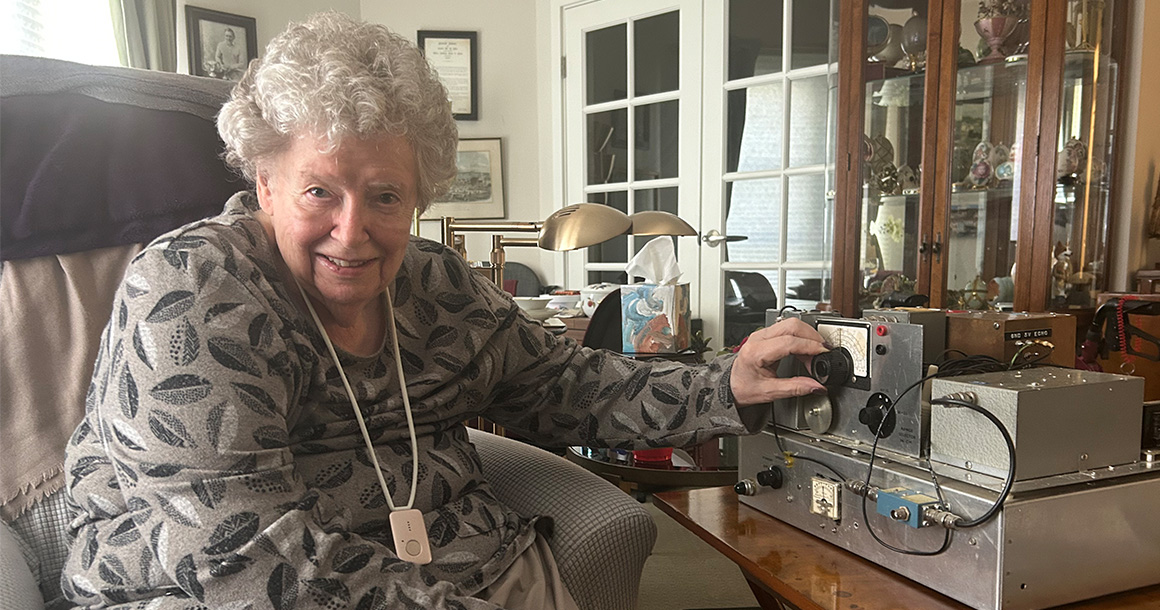
As a young woman, Joan P. Baker wanted to go to medical school.
But in order to get in, she needed a language other than English on her transcript, and she had unfortunately failed French. So, she turned to plan B: bypassing medical school to work in radiography.
Baker, who was born and raised in Chester, England, initially worked in the field at a small local hospital before moving to London in 1960 — where her twin sister was living and working — at her father’s suggestion. This was just the start of a career that would eventually lead Baker to create the occupation of sonography in the United States and become a faculty member for the Diagnostic Ultrasound program at Bellevue College from 1989 to 2004.
Once in London, Baker worked at St. Mary’s Hospital and the National Hospital for Nervous Diseases (now called the National Hospital for Neurology and Neurosurgery), where at the latter, she said she was the “last hired and least qualified, and had the dubious honor of doing what others had already done and felt were a waste of time.” Yet, while she was there, she received an invitation from Stanford Medical Center to work in neuroradiology and ultrasound in Palo Alto, California. It was a big invitation, both professionally and personally, for someone in their early 20s to move halfway across the world.
“He didn’t know how old I was. It’s a question you’re not allowed to ask, right?” Baker said with a laugh. “I don’t know whether that would have made a difference. There were only a handful of us in the world that were doing ultrasound.”
Being young and adventurous, Baker, now 83 and living in Bellevue, accepted the invitation, arriving in California in 1965.
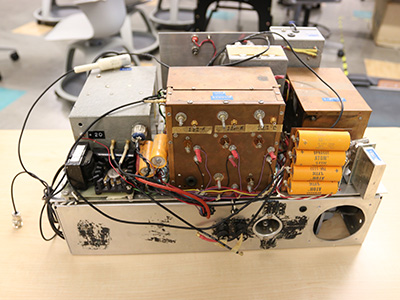
Once Baker got to Stanford, she realized that her new colleagues at Stanford had less experience working in ultrasound than she’d expected, whereas she had been doing ultrasounds for about five years. It was a big adjustment, and Baker was academically lonely. She didn’t have anyone to talk about the trade with or bounce ideas off of when it came to patient results. The field was so small at that time that, in 1969, when Baker attended a medical conference in Winnipeg, Canada, out of the roughly 135 people in attendance, only about half a dozen (including Baker) worked in her particular field.
Baker suggested they form a professional organization to talk within their field of medicine. By the next year, they had doubled in size, with 13 members. That organization, the Society of Diagnostic Medical Sonography (SDMS), still exists today and, according to its annual report for 2024, is the largest association of sonographers and sonography students in the world with more than 23,000 individual and organizational members. Baker said while seeing the growth in the field has been tremendous, there was no way to predict it. She just happened to be in the right place at the right time.
A Champion of Her Field
In order for the field of sonography to grow, Baker realized that there had to be a way to measure people’s competency. As a result, she helped form the American Registry of Diagnostic Medical Sonography (ARDMS), as well as the accreditation for schools, which would allow students to apply for grants.
And while this was a lot of work, Baker said the SDMS’s biggest challenge was getting the American Medical Association (AMA) to classify sonography as its own separate occupation. The AMA initially wanted to put sonography under x-rays, even though Baker and her fellow sonographers felt they didn’t really have anything in common with x-rays.
“You had to think three dimensionally,” Baker said about the difference between ultrasound and x-ray. “Your anatomy was different. We weren’t taking pictures of bones. We were taking soft tissue, and it was at as many angles (as possible). Its pattern was what we were interested in.”
Baker sought out Dr. Gilbert Baum, who was president of the American Institute of Ultrasound in Medicine at the time and helped them make their case with the AMA. It worked and sonography was approved as its own field in 1973.
Baker said she was consumed by and fascinated with sonography because when she started out, she was doing it in the brain, the only place it was being done at the time, emphasizing the importance of getting the correct views to result in a correct diagnosis. She said it was important that she fell in love with her work, especially since it was new at the time, and she had to be a champion of the field.
“You’ve got to love what you do, because you have lots of disappointments,” she said.
Since creating the occupation of sonography, Baker’s career included setting up and chairing the department of allied health at Seattle University, where she also worked as an assistant professor, and working as a marketing consultant at Diagnostic Ultrasound Corporation on the Eastside, in addition to her time at Bellevue College.
A Challenging but Rewarding Career
Looking back on her career, and the field of sonography, Baker said it has been very exciting to see the field grow at the rate that it has. She said creating the occupation may have “put 10 years on (her) life,” but it benefits the most people out of everything she has done.
“I think we did a good job of setting a good standard, a high standard, which serves the new sonographers well, because if they are to grow with the field, they have to fundamentally understand it,” Baker said.
And when it comes to her time as an educator, Baker said her students were very enlightening.
“I claim a little bit of each one of them as my satisfaction in the field,” she said. “To be a teacher is very challenging. But at the same time, it’s very rewarding, and if you claim a little bit of everybody’s success, it’s much larger than just if you’ve worked hard yourself.”
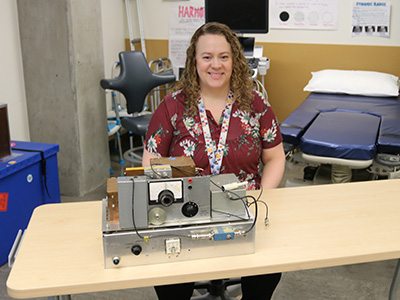
Thinking back specifically of her time at Bellevue College, Baker said one of her favorite memories was of former President Jean Floten, whose first day on the job was also Baker’s first day at the school, and was a great leader.
Baker said the school was a lovely place to work, and she has nothing but fond memories of her time at the college. Even with the trials that come with every workplace, everybody was moving in the right direction, and trying to do their best and give the students their best.
In terms of the students, Baker said it was “a great place to teach because the students really wanted to learn,” adding that they were self motivated and the program was very difficult — not a typical associate degree program.
“What is important to realize when you educate people in sonography, like other allied health fields, they have to perform perfectly. There’s no room for error,” she said. “The faculty become the gatekeepers for the profession, and they protect the public, and that’s important.”