
Changing the Game: Learning Chemistry While Incarcerated
Jun 25, 2026Most educators love teaching classes with engaged students. One such class that Dr. Sonya Doucette, a chemistry professor at Bellevue College, taught was filled with 18 curious, attentive, and excited-to-learn students. They were also incarcerated.
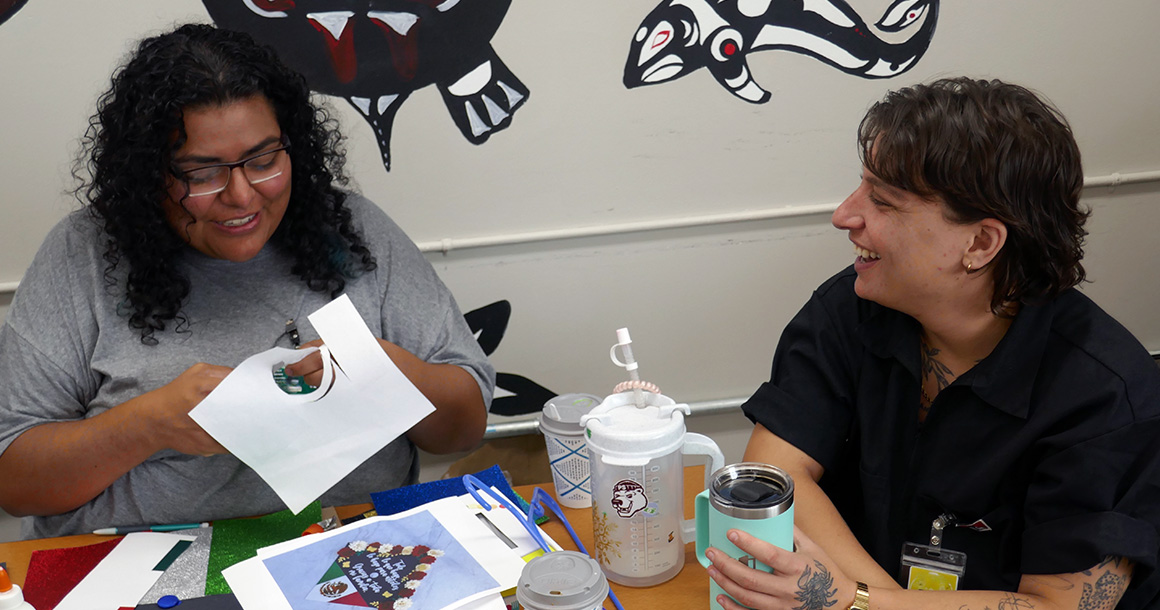
Most educators love teaching classes with engaged students. One such class that Dr. Sonya Doucette, a chemistry professor at Bellevue College, taught was filled with 18 curious, attentive, and excited-to-learn students. They were also incarcerated.
Doucette teaches Chemistry 110 at the Washington Corrections Center for Women (WCCW) in Gig Harbor, Washington, under the auspices of the Freedom Education Project Puget Sound. She also teaches students at Bellevue College. Both positions leverage her chemistry training and expertise. One requires a little bit of extra planning, logistics, and flexibility.
“Teaching chemistry at WCCW is a lot more work than at Bellevue College, but it is incredibly rewarding to teach there,” Doucette said. “I am always humbled and inspired by the students, who are pursuing a college education in a challenging environment not conducive to being a college student.”
Chemistry 110 at the corrections center covers atomic and molecular structure, measurement, the periodic table, and many other chemistry topics. It also includes a lab, which is where some of the challenges come in.
Because of safety and other prison-related concerns, all materials for the labs have to be approved in advance, often brought in unopened, and always in non-glass containers. This makes a device as simple as a thermometer tricky, Doucette said. The approval for the lab materials is good only for approved days, and if there is a need to cancel class, for a ‘cease movement’ (lockdown) or other unexpected event, then the entire lab approval process has to be redone for other days. She can’t bring in matches, rubbing alcohol or Windex; materials she often uses for labs in this course. Often, classes are canceled with no notice.
Time and resource constraints, along with the unpredictable nature of corrections education, can feel daunting, Doucette said.
But it’s important to Doucette, for personal reasons. A close relative was recently incarcerated, and Doucette acutely saw the need for education, positive activities, and intellectual stimulation in the prison system.
“My relative was hungry for information,” she said. “They had minimal reading materials, no ability to take classes, and were super bored and traumatized. That was the reason I was initially interested in teaching in a prison.”
It makes a difference. According to several studies, the odds of recidivism decrease as incarcerated people achieve higher levels of education. Incarcerated people who participate in such programs are 48% less likely to go back to prison than those who do not. Doucette saw firsthand how people exiting prison can be left with minimal to no financial resources and skills, especially if they lack the support of family and friends on the outside. A college degree gives them a better chance to rebuild their lives.
Freedom Education Project Puget Sound Staff Make it Possible
With motivation in place, Doucette started researching teaching options. She had a colleague at another college who taught at a prison in Monroe, Washington, so she knew it was possible. She then discovered the Freedom Education Project Puget Sound, which administers the college program. Bellevue College supports her effort by counting this class as part of her Full Time Equivalent (FTE) workload.
So far, through the Freedom Education Project Puget Sound, 88 students have earned an associate degree while incarcerated. After leaving prison, those students have gone on to attend the University of Washington in Seattle and Tacoma, Evergreen State University, Central Washington University, University of Puget Sound, and numerous community colleges.
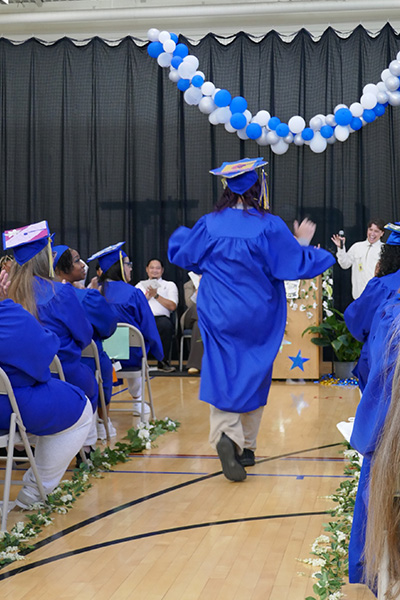
Doucette says the Freedom Education Project Puget Sound staff are amazing.
“I absolutely could not do this without their help, support, and good humor,” Doucette said. Paid staff include learning assistants, who are incarcerated people at the corrections center who have earned a degree. “Learning assistants make the classroom run so much more smoothly than if it was only me.”
At the corrections center, attendees work toward either an associate degree (sponsored by Olympic College in Gig Harbor) or a Bachelor of Arts (sponsored by the University of Puget Sound in Tacoma). Doucette’s twice-a-week class is one of only a few science offerings in the program. It has inspired some participants to further their science training.
Students See Science Education as Door-Opening
Several of the students enrolled in Doucette’s spring class identified higher education and science education, specifically, as important to their future success.
Student Kallie, who plans on getting a Ph.D. and becoming a therapist once she is released, was surprised to learn that chemistry is everywhere in life. She said learning chemistry is like learning a whole new language, and like all new languages, it provides additional perspective and ways of looking at the world.
It’s very personal for student Bethany. When young, Bethany received the message that she was “dumb,” and is now getting her degree to change that narrative, for herself and others. She said learning things on an atomic level and then getting to practice hands-on in the lab has made learning chemistry, a difficult science, possible. She’s excited about continuing to learn and grow and is still exploring where she wants to focus in the future.
Cherise, another student in the Freedom Education Project Puget Sound, will be graduating with her associate of arts degree later this year, and a science lab was a requirement for her degree. She calls herself a professional learner and plans to continue pursuing education upon release.
All of them enjoyed learning from Doucette and expanding their world views through science education.
Working Inside Brings Personal Benefits
Working at the corrections center feeds Doucette’s passion for social justice and desire to impact the system’s inequities. On a professional level, Doucette has found that she gets real-time feedback on her teaching style; her students are open with her in a way that she doesn’t see with the more traditional populations she teaches at Bellevue College. They have helped her improve the way she teaches the course in any context.
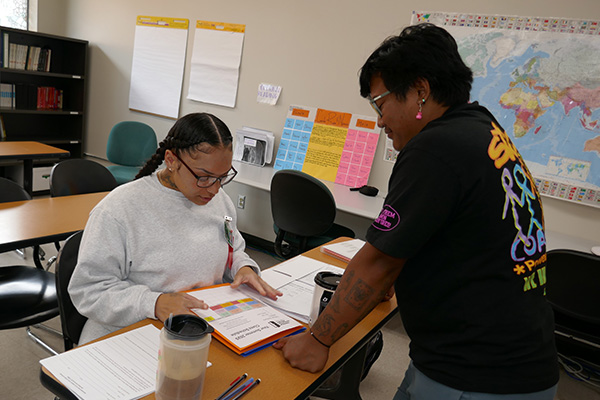
“At Bellevue College, I sometimes have to wait until the end of the quarter to see how well I’m doing,” she said. “At the corrections center, the students tell me right then and there how it’s working for them, so I can adjust quickly.”
Doucette has taught at Bellevue College since 2013, working in both the Chemistry and Environmental Science programs. At Bellevue College, her students have carried out research projects on topics such as the effect of pesticides on bees, Puget Sound air pollution, and biodiesel fuel.
Although spring 2025 was Doucette’s first time teaching in a prison, it won’t be her last. Doucette has continued teaching Chemistry 110 to 22 students in spring quarter 2026 and has been invited to create additional science courses for upper-level students in the future.
Why is she so committed? In her own words: “A lot of people don’t know how important education is for helping people make their way on the outside, after being released from prison. Having access to a degree can be a game changer, and I hope to help change the game.”