
At the Corner of Education and Healthcare
Jun 8, 2026As demand for healthcare workers continues to grow, Bellevue College has become a steady source of trained professionals through its Nursing and Radiologic Technology programs.
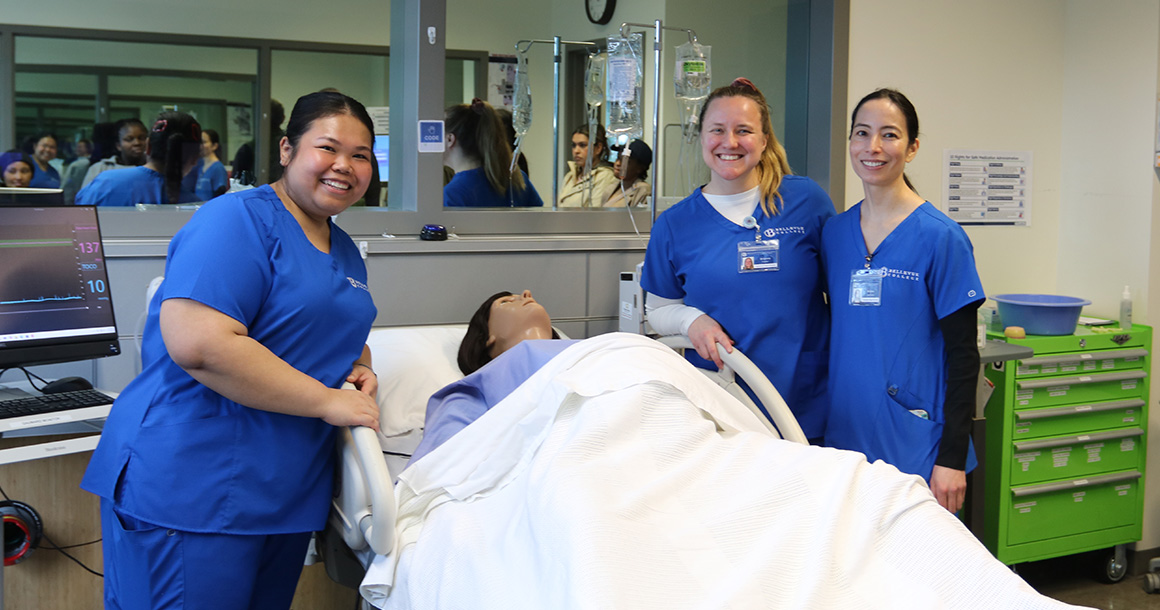
Retired Bellevue College biology professor Diane Mauldin once joked that it is nearly impossible for her to attend a medical appointment without seeing a former student working somewhere in the clinic or hospital. It is a lighthearted observation, but it reflects a measurable reality. Across Bellevue and the surrounding region, healthcare systems are staffed by graduates trained close to home. Many of them began their careers at Bellevue College.
As demand for healthcare workers continues to grow, Bellevue College has become a steady source of trained professionals through its Nursing and Radiologic Technology programs. These programs are designed to meet regional workforce needs while expanding access to education for students who may not follow traditional academic paths. The result is a direct connection between education and patient care across the Eastside and throughout the Puget Sound.
Civic leader and former Bellevue College Foundation president Sarah Langton has watched that growth firsthand. She observed the college’s transition from Bellevue Community College to Bellevue College and saw how its mission expanded alongside a rapidly developing city.
“Bellevue College meets people where they are,” Langton said. “Students balancing work, family and education can find flexible pathways here, and that flexibility is essential for building a workforce our region actually needs.”
That accessibility is central to the Nursing program. Program chair Minnat Hamada understands its value from personal experience. She graduated from Bellevue College’s nursing program before working at Valley Medical Center, becoming a school nurse within the Kent school district, a Public Health nurse consultant, and as a practicing nurse at Swedish and Harborview hospitals. Now in her seventh year teaching, she leads a program that reflects the diversity and life experience of its students.
“Our students often come to nursing after other careers,” Hamada said. “They bring real-world perspective into the classroom, and that translates into stronger patient care.”
Students can earn an associate degree in Nursing or continue into a Registered Nursing to Bachelor of Science in Nursing (commonly known as RN to BSN) pathway designed for working professionals. Bellevue College also offers a nurse refresher program for licensed nurses returning to practice. That refresher program is the only one of its kind on this side of the state and serves professionals who need updated credentials or renewed licenses.
Clinical placements are a core part of training. Students gain experience at hospitals and care centers across the region, including Valley Medical Center, Swedish in Seattle, Harborview, EvergreenHealth, Snoqualmie Valley Health and Overlake Medical Center. They also work in King County mobile clinics and complete internships at rehabilitation centers and psychiatric facilities.
The program also supports public health initiatives while providing a lifeline for programming that needs able-bodied medical professionals to staff up in a crisis. Between October 2024 and March 2025, Bellevue College nursing students partnered with King County to administer vaccines in public schools. More than 440 vaccinations were provided to students across Bellevue, Renton, Seattle, and Shoreline districts. The clinics allowed children to meet school health requirements without missing significant class time. The effort relied heavily on Bellevue College student volunteers.
Demand for the program remains high. Each nursing cohort admits 32 students, with cohorts beginning in fall, winter and spring. One recent winter session drew 85 applicants for those 32 seats. Local healthcare providers say the impact is clear.
Lisa Morten, Chief People Officer at Overlake Medical Center, said Bellevue College graduates make up a significant portion of the hospital’s hiring pipeline. Over the past year, Overlake hired 460 nurses. Of those, 155 came from Bellevue College, or about 30% of new nursing hires.
“They arrive ready to work,” Morten said. “They understand patient care, teamwork and clinical expectations from day one.”
Overlake is a nonprofit healthcare system whose values include integrity, compassion, agility, respect, and engagement. Bellevue College graduates align closely with those principles, Morten said, adding that new graduates often introduce updated procedures and current best practices. This can strengthen teams where staff members may have worked in place for many years.
“That new perspective benefits everyone,” she said.
The relationship between Overlake and Bellevue College extends beyond hiring. The hospital has used campus facilities for meetings and training sessions and offers employees tuition reimbursement of up to $10,000 per year. Morten noted that the partnership spans decades. A scholarship document recently found in hospital records showed that Overlake supported Bellevue College students as early as 1992.
Radiologic technology students contribute to the same hospitals and healthcare facilities in the area. They train in labs using state-of-the-art imaging equipment and complete clinical rotations in medical settings, building skills that allow them to enter diagnostic and imaging roles after graduation. Like nursing students, they leave the program with practical experience, not just coursework. Langton said that kind of preparation is what makes Bellevue College essential to the region’s long-term stability.
“The college aligns education with real workforce needs,” she said. “That benefits students, employers, and the entire community.”
For the Bellevue region, the presence of these programs means hospitals and clinics have access to trained professionals who understand local systems and patient populations. For students, it means access to affordable education that can lead directly to meaningful careers. For the broader Puget Sound, it means a stronger healthcare workforce prepared to meet rising demand.
In Bellevue, the connection between education and healthcare is visible every day. It appears in exam rooms, imaging suites and hospital corridors across the region. For a growing city and an expanding region, ready-to-work healthcare providers are simultaneously an institutional success story and a strong foundation for a robust community infrastructure.