
foundry10 Works with Foundation to Support Healthcare Student Success
Oct 7, 2026The Bellevue College Foundation can now award work-based learning scholarships to three times as many healthcare students as in years past.
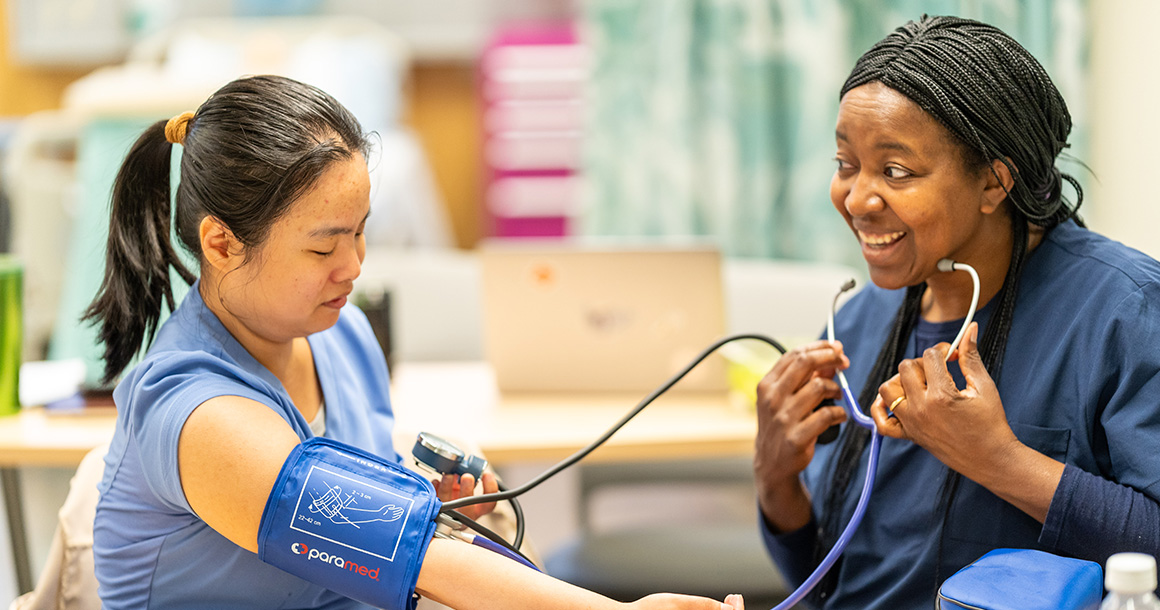
Work-based Learning Scholarships and New Healthcare Equipment Now Available to More Students
The Bellevue College Foundation can now award work-based learning scholarships to three times as many healthcare students as in years past. That’s thanks to a recent $423,000 donation made by foundry10, a Seattle-based educational research organization that supports learning through philanthropic partnerships.
“This is going to dramatically increase our number of students who can receive these scholarships,” said Sean Marsh, Bellevue College’s vice president of Institutional Advancement and executive director of the Foundation.
Last year, the Foundation awarded scholarships to 166 healthcare students across 15 programs for a total of $750 each. This year, they expect to award close to 500 students with the funding allocated for work-based learning support.
“Our mission is to support students at Bellevue College so they can achieve their dreams and goals,” said Marsh. “foundry10’s donation helps make those dreams a reality.”
Health Sciences Work-based Learning Scholarships
Disbursed on a quarterly basis, students who take courses focused on work-based learning within Bellevue College’s Health Sciences, Education and Wellness Institute, such as clinical rotations off campus or capstone research projects, are eligible to apply. These courses are required for their degree or certificate, which leads to future employment in the healthcare industry, but this can sometimes come with hidden costs.
Clinical rotations, for example, require students to park in hospital parking lots, which can sometimes be upwards of $20 per day. Other hospitals require students to pay for their own branded scrubs or purchase their own lead markers — x-ray blocking tools used to note the left and right side of anatomy.
“Students are just incurring that cost in order to complete their education,” Marsh said, noting that many applicants have varied levels of income and some may not be working so that they can pursue their education.
Although the partnership with foundry10 has been established for several years, the Bellevue College Foundation noticed much higher student need last year when far more students applied for the internship scholarship than funds were available.
This increase is representative of the need the Foundation has seen in other areas, such as within the Foundation’s larger annual scholarship, at Bellevue College’s Benefits Hub Food Pantry on campus, and through the Student Safety Net Fund and other emergency funding resources.
The students who benefit the most include those who don’t qualify for financial aid. Some may be those in clinicals within the Nursing Assistant program but don’t qualify due to the duration of the program. Others include students who have already completed a Registered Nursing to Bachelor of Science in Nursing (RN to BSN) but are enrolled in advanced courses so that they can grow in their careers to help fill a major nursing shortage in the area.
What’s particularly meaningful, however, is that these funds make a difference in students’ educational success. In an annual impact report, the Foundation and college tracked the retention and completion rates of students who received the work-based scholarships in past years, along with their grade point averages, and determined that the scholarship recipients graduated at twice the rate of a general student at the college and their grade point average exceeded the collegewide average for every quarter since the program’s beginning.
“We have been thrilled to see the thoughtful ways the Bellevue College Foundation has been able to identify the needs of students and propose impactful interventions,” said Danny Brzovic, foundry10. “The success of both the Foundation’s and students’ efforts demonstrates how the removal of barriers allows for each individual to be their most capable.”
New Healthcare Equipment
In addition to scholarship support, approximately $55,200 of the donation will purchase new equipment that will bolster student learning within several healthcare programs at Bellevue College.
The new equipment includes a hospital-grade pediatric crib and training mannequins for the college’s Nursing and Certified Nursing Assistant programs, a transvaginal ultrasound trainer for the Diagnostic Ultrasound Technology program, and a portable x-ray machine for the Radiologic Technology program.
“Offering programming that is aligned with the future work experiences students will have and with the needs of our clinical and community partners is a core focus of our Health Sciences curricula and our Be Bold Strategic plan,” said Bellevue College’s Provost Dr. Jess Clark. “When students learn with the actual equipment they will use to care for patients, it builds their workforce skills and embodies our mission, values, and commitment to serving our local and regional communities.”
The new purchase of a transvaginal ultrasound trainer will have a significant impact. The college’s Diagnostic Ultrasound Technology program offers obstetrics and gynecology (OB/GYN) as a pathway within its program. As part of that track, students learn to become ultrasound technologists, also known as sonographers.
While the program is one of the longest-established and best-known programs of its kind in Washington state, there are limited opportunities for students to train or practice transvaginal ultrasounds prior to performing one on a patient, as the college only has one device. This donation will change that.
“We currently only have one transvaginal ultrasound phantom, which allows for one student to practice with it at a time,” said Stephanie Campbell, Diagnostic Ultrasound Program Chair at Bellevue College. “Having more than one will allow students to become much more proficient at this type of sensitive exam before going to clinicals and performing them on real patients.”
The technology will help students learn to identify normal and abnormal structures, pregnancy, and other areas of women’s and transgender people’s healthcare.
“Because of the sensitive nature of these exams, it’s imperative that our students feel confident in acquiring these types of ultrasound images,” Campbell said. “Having access to this equipment allows faculty to help students build technical and professional skills so that they can go out into the field best prepared to serve our community.”
Other equipment, like the portable X-ray machine, will expand hands-on learning for students, and it will also foster cross-program collaboration. With its portability, this tool could be used by Radiologic Technology students in one of the Institute’s “mass casualty simulation events,” which is a Nursing training opportunity that happens three times a year. The event is held at Bellevue College’s teaching clinical laboratory that can accept real patients in the event of a mass incident. Actors, law enforcement, medical personnel, and a dedicated special effects team present an authentic and life-like simulation for Nursing students. This donation will expand that learning experience for other students for years to come.
“Healthcare is interconnected, with patients’ needs touching many professions and specialties,” Clark said. “Donations like foundry10’s allow Bellevue College to foster collaboration across professions, producing a next generation of healthcare workers with experience in multiple departments who can consider the whole health of their patients.”
About foundry10
foundry10 is an education research organization with a philanthropic focus on expanding ideas about learning and creating direct value for youth. In collaboration with a wide range of partners, they surface, evaluate, and share opportunities to better support youth learning both inside and outside the classroom. Building on more than a decade of impactful work, their unique approach blends applied and experimental research, philanthropy, and education programs rooted in evidence-based best practices.